Sound-Designed Human and Animal Voices for Non-human Voice Conversion

Designed Vocalizations Dataset

Seolhee Lee1, Minsu Kang1, Yangsun Lee1, Woosun Min1, Choonghyeon Lee1, Namhyun Cho1,2
1 NC AI Co., Ltd, Republic of Korea
2 Sogang University, Republic of Korea
{seolhee, mskang, yyslee0301, choonghyeon, cnh2769}@ncsoft.com, woosun1108@naver.com
Accepted to Interspeech 2026

Advances in AI-based voice conversion have enabled a wide range of media applications, including films, audiobooks, and games. However, most research and public benchmarks still focus on natural human speech, leaving designed vocalizations such as monster growls and robotic voices underexplored, partly due to the lack of publicly available resources. To address this gap, we introduce the Designed Vocalizations Dataset, created by applying professional vocal effects processing to diverse vocal sources to produce paired original and effect-modified audio. We further provide a standardized test set with explicit seen/unseen splits over source types and preset styles to assess generalization under controlled conditions, together with baseline benchmark results for reproducible evaluation.

The dataset is currently undergoing internal legal review at our company prior to public release.
We plan to make it publicly available before the conference begins.
01

Dataset overview

A compact figure-style summary of the training split and benchmark construction.
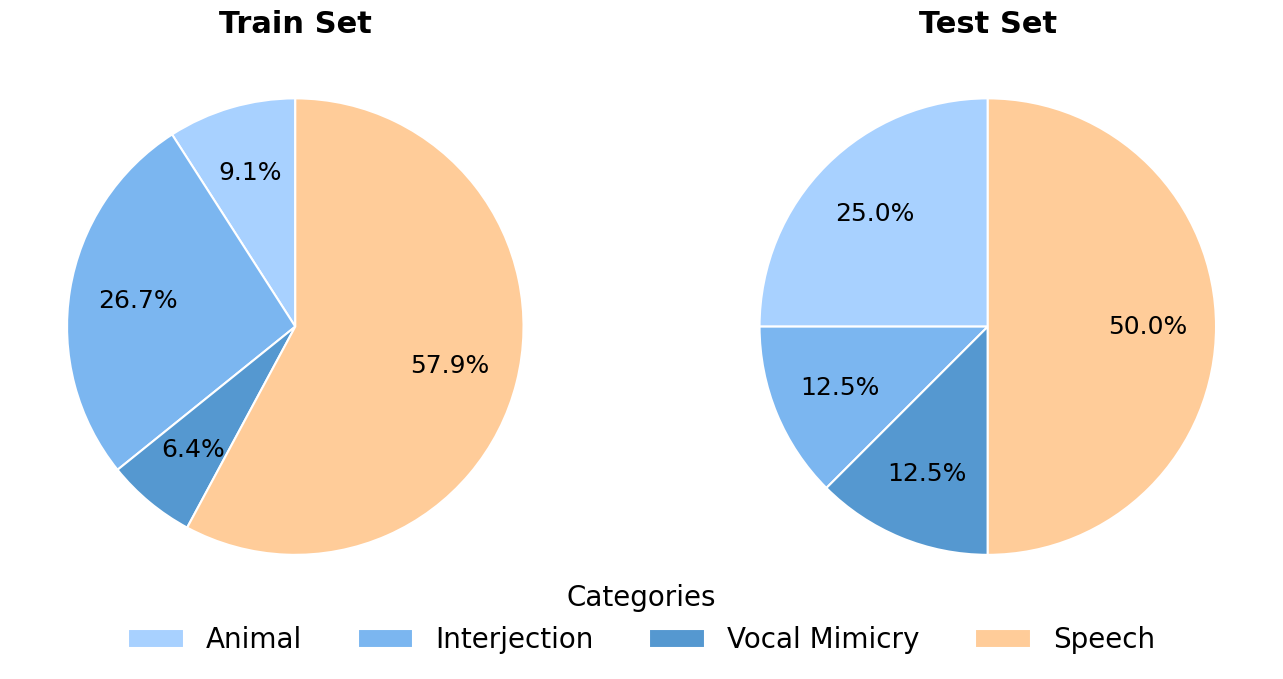
Source category distribution.
Source category distribution. This figure highlights how the train and test splits differ in source composition across speech, interjection, animal, and vocal mimicry categories.
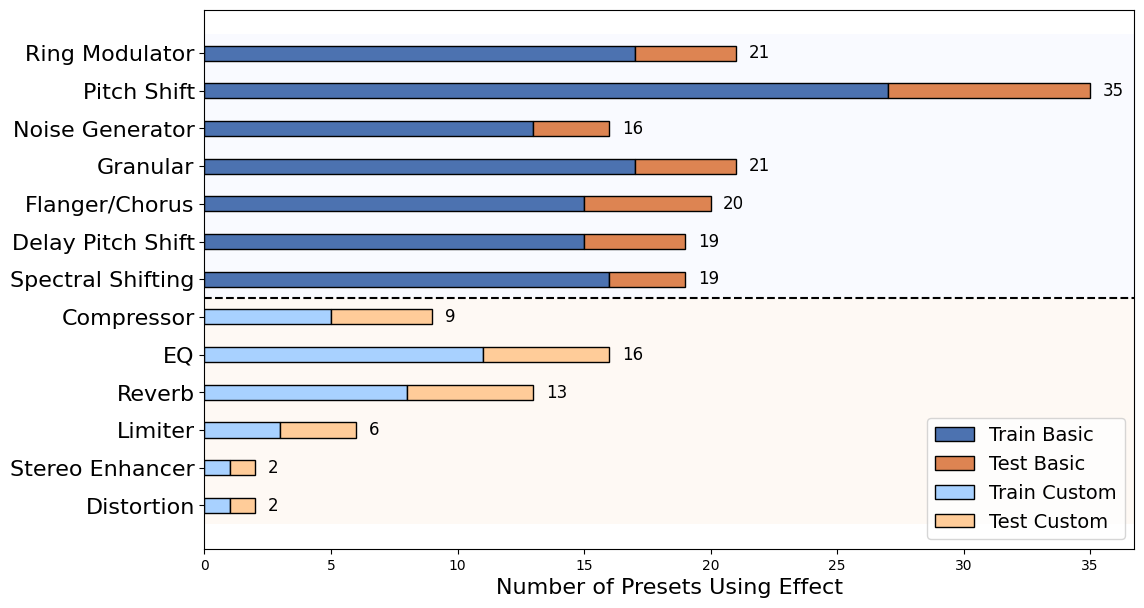
Effect usage distribution.
Effect usage distribution. This figure summarizes how effect modules are distributed across training and test presets, including the Dehumaniser base effects and the additional effects used in custom presets.
Train
Total 231,814
Raw audio
5,654
source vocalizations
Linguistic3,270
Non-linguistic2,384
+
Designed audio
226,160
effect-processed vocalizations
Produced with 40 training presets
Train split provides non-parallel raw and designed audio for model training.
Test
Total 5,640
Sources
120
benchmark inputs
Seen-source60
Unseen-source60
×
Presets
47
benchmark preset conditions
Seen-preset40
Unseen-preset7
seen-source = benchmark inputs from timbre groups present in training
seen-preset = benchmark presets also used in training
02

Dataset structure

A compact reference for how the released dataset is organized on disk and what metadata fields are provided.
Directory structure
DesignedVocalizationsDataset/
  README.md
  LICENSE

  metadata/
    info/
      source_info.csv
      preset_info.csv
      preset_chains.csv
    splits/
      train_files.csv
      test_pairs.json

  audio/
    train/raw/
    train/designed/
    test/source/
    test/reference/
Audio files
44.1 kHz · 16-bit WAV
train/raw and train/designed audio for non-parallel learning
test/source and test/reference for source-reference evaluation
Metadata schema
Field
Description
audio_id
Unique item identifier
file_path
Relative path to the audio file
split
train or test
source_type
speech, interjection, animal, or vocal mimicry
preset_id
Preset condition identifier
duration
Clip duration in seconds
tags
Optional descriptive tags and notes
03

Source pool examples

This section shows representative examples from the raw source pool used to build the dataset.
04

Target preset pool examples

This section shows representative presets chosen to illustrate broad stylistic tendencies in the full preset pool. These are coarse listening-oriented examples, not exhaustive categories of the full preset inventory.
Original source
05

Benchmark voice conversion result samples

Each sample shows output from the Human-to-Non-Human Voice Conversion model (H2NH-VC), used in the paper as a baseline voice conversion.
Source · raw vocalization to be converted
Reference · target designed vocal style
Output · baseline conversion result